
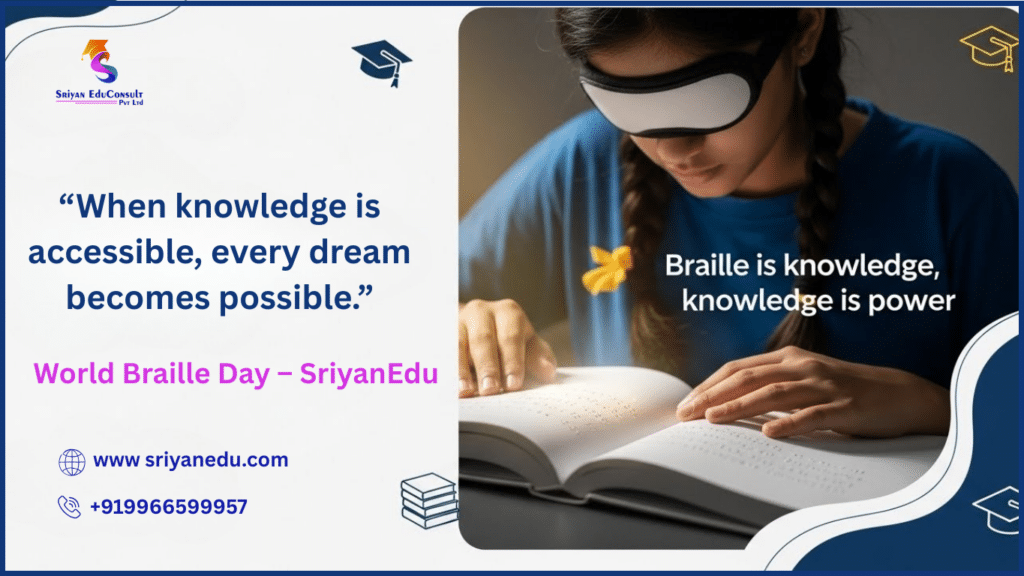
Introduction to World Braille Day
World Braille Day, observed annually on January 4, marks the birth anniversary of Louis Braille, the inventor of the Braille writing system. This day stands as a global reminder of the importance of accessibility, inclusion, and equal opportunities in education. World Braille Day is not only about honoring an invention; it is about reaffirming the belief that education should be accessible to every learner, without barriers.
Within the first 210 words, it is important to understand that World Braille Day highlights the educational rights of visually impaired individuals and the need for inclusive learning systems. Braille enables students to read, write, and learn independently, making it a cornerstone of accessible education. When learning environments are designed with accessibility in mind, they empower students to participate equally and confidently.
SriyanEdu is committed to empowering students through inclusive, accessible, and future-ready education, supporting equal learning opportunities for every learner.
Understanding Braille and Its Educational Importance
Braille is a tactile reading and writing system that uses raised dot patterns to represent letters, numbers, and symbols. Even in today’s digital-first world, Braille remains essential for developing strong literacy skills among visually impaired learners. World Braille Day reminds us that true education is not limited to listening but includes the ability to read, write, and comprehend independently.
Braille strengthens spelling, grammar, and cognitive development while fostering confidence and independence. Students who learn through Braille are better equipped to succeed academically and professionally, reinforcing its continued relevance in modern education.
World Braille Day and Inclusive Education
Inclusive education ensures that students of all abilities learn together in supportive and adaptable environments. World Braille Day reinforces the principle that inclusion is a responsibility, not an option. When Braille resources and accessible teaching practices are integrated into mainstream education, visually impaired students gain equal access to knowledge and opportunities.
Inclusive classrooms also benefit all learners by promoting empathy, collaboration, and respect for diversity. An inclusive education system prepares students to thrive in a diverse and equitable society.
Importance of Accessible Education for All Students
Accessible education is the foundation of equal opportunity. Many visually impaired students still face challenges such as limited access to Braille materials, inaccessible digital platforms, and a lack of trained educators. World Braille Day brings attention to these barriers and encourages institutions to take meaningful steps toward accessibility.
When education is accessible, students experience improved academic outcomes, increased confidence, and greater independence. Accessible education benefits not only individuals but also society by creating a more inclusive and skilled workforce.
Role of Technology in Advancing Braille Accessibility
Technology has significantly expanded access to Braille through refreshable Braille displays, screen readers, and digital Braille libraries. World Braille Day celebrates how innovation can enhance accessibility when inclusivity is prioritized from the start.
Educational platforms that follow accessibility-first design principles ensure that digital learning remains inclusive. As education continues to evolve, accessibility must remain central to innovation.
Education for All: Turning Awareness into Action
World Braille Day becomes meaningful when awareness leads to action. Schools and colleges can support inclusive education by providing Braille learning materials, training educators in inclusive teaching methods, and ensuring that both physical and digital infrastructures are accessible.
Students, educators, and communities also play a vital role by advocating for accessibility and supporting inclusive learning environments. Inclusive education succeeds when it is embraced collectively.
Why World Braille Day Matters for the Future
As education becomes increasingly digital, accessibility must be built into every learning system. World Braille Day reminds us that progress is meaningful only when it includes everyone. Braille continues to be a powerful tool for ensuring that visually impaired learners are not excluded from educational advancement.
By promoting Braille literacy and inclusive education, societies can reduce inequality, expand employment opportunities, and empower individuals to live independent and dignified lives.
Conclusion
World Braille Day is a powerful reminder that accessibility is essential for true inclusion. Braille symbolizes knowledge, independence, and equal opportunity in education. When learning systems prioritize accessibility, they create pathways for every student to succeed.
Because when education is accessible, success becomes universal—SriyanEdu supports this vision.