
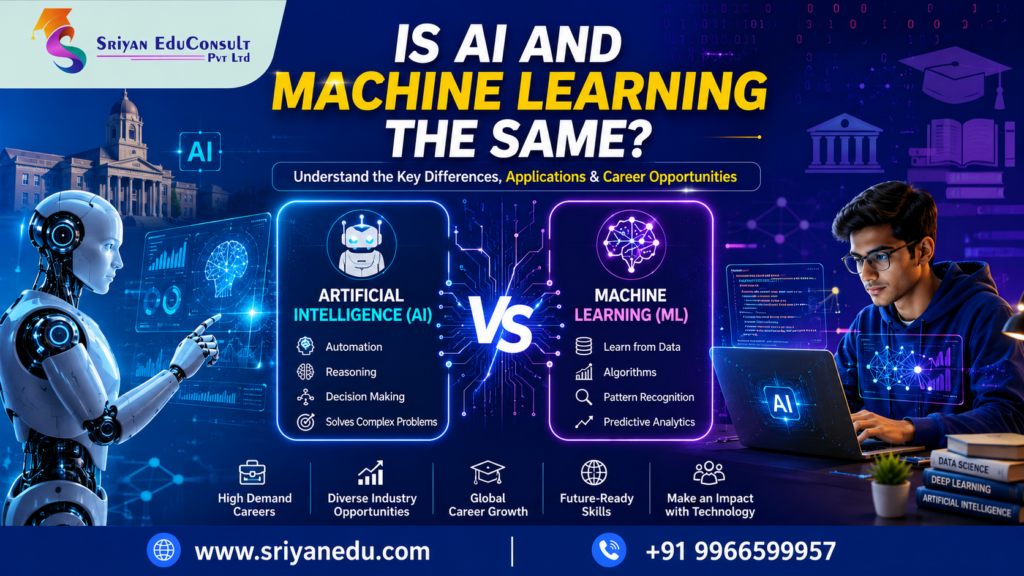
Artificial Intelligence (AI) and Machine Learning (ML) are among the most discussed technologies in today’s digital world. They are transforming industries such as healthcare, finance, education, manufacturing, cybersecurity, and transportation. However, many students and professionals often ask the same question: Is AI and Machine Learning the same?
The short answer is No. While they are closely related, Artificial Intelligence and Machine Learning are not identical. Machine Learning is a subset of Artificial Intelligence, meaning every Machine Learning system is AI, but not every AI system uses Machine Learning.
Understanding this difference is essential for students planning a career in technology. If you’re considering courses in AI or ML, Sriyan Educonsultancy Pvt. Ltd. can guide you in choosing the right university and career path.
What is Artificial Intelligence (AI)?
Artificial Intelligence refers to the ability of machines to simulate human intelligence. AI systems are designed to perform tasks that usually require human thinking, such as:
- Learning
- Problem-solving
- Decision-making
- Understanding language
- Recognizing images
- Planning and reasoning
The primary goal of AI is to create intelligent systems capable of performing tasks autonomously while improving efficiency and accuracy.
Examples of AI
- Virtual assistants
- Self-driving vehicles
- Smart recommendation systems
- Fraud detection software
- AI-powered chatbots
- Medical diagnosis systems
AI includes several technologies, including:
- Machine Learning
- Deep Learning
- Natural Language Processing (NLP)
- Robotics
- Computer Vision
- Expert Systems
Machine Learning is only one component of the larger AI ecosystem.
What is Machine Learning (ML)?
Machine Learning is a branch of Artificial Intelligence that enables computers to learn from data without being explicitly programmed.
Instead of following fixed rules, ML algorithms identify patterns from historical data and improve their predictions over time.
Machine Learning Process
- Collect data
- Clean and prepare data
- Train the model
- Test performance
- Make predictions
- Improve accuracy using more data
The more quality data an ML model receives, the better its performance becomes.
Examples of Machine Learning
- Email spam filtering
- Movie recommendations
- Product recommendations
- Credit card fraud detection
- Face recognition
- Speech recognition
These systems continuously improve as they process additional information.
Is AI and Machine Learning the Same?
The answer is No.
Artificial Intelligence is the broader concept of making machines intelligent, while Machine Learning is one approach used to achieve that intelligence.
Think of it like this:
- AI is the entire universe.
- Machine Learning is one planet within that universe.
Every Machine Learning application belongs to AI, but AI also includes many techniques that do not involve Machine Learning.
AI vs Machine Learning: Key Differences
| Feature | Artificial Intelligence | Machine Learning |
|---|---|---|
| Definition | Makes machines intelligent | Enables machines to learn from data |
| Scope | Broad field | Subset of AI |
| Goal | Simulate human intelligence | Learn patterns and make predictions |
| Programming | May use predefined rules | Learns automatically from data |
| Data Dependency | Not always required | Requires data |
| Learning Ability | May or may not learn | Continuously improves through learning |
| Examples | Robots, virtual assistants | Recommendation engines, spam filters |
Relationship Between AI and Machine Learning
The easiest way to understand their relationship is:
Artificial Intelligence contains several technologies.
One of these technologies is Machine Learning.
Inside Machine Learning is another advanced technology called Deep Learning.
The hierarchy looks like this:
- Artificial Intelligence
- Machine Learning
- Deep Learning
- Machine Learning
This explains why these terms are often used together.
Real-Life Examples
AI Example
A customer service chatbot can answer questions using predefined rules and Natural Language Processing.
It may not necessarily learn from previous conversations.
Machine Learning Example
A shopping website recommends products based on your browsing history.
The recommendation improves as it collects more user behavior data.
Why Do People Confuse AI and Machine Learning?
There are several reasons:
- News articles often use the terms interchangeably.
- Most AI applications today use Machine Learning.
- Marketing campaigns simplify technical concepts.
- Both technologies frequently work together.
Understanding their distinction helps students make informed educational and career decisions.
Applications of Artificial Intelligence
Artificial Intelligence is widely used across industries.
Some major applications include:
- Healthcare diagnosis
- Autonomous vehicles
- Smart assistants
- Robotics
- Cybersecurity
- Manufacturing automation
- Financial risk analysis
- Language translation
- Personalized education
- Smart cities
AI continues to expand into nearly every sector.
Applications of Machine Learning
Machine Learning powers many intelligent systems.
Popular applications include:
- Netflix recommendations
- YouTube video suggestions
- Banking fraud detection
- Medical image analysis
- Predictive maintenance
- Customer behavior analysis
- Weather forecasting
- Voice assistants
- Search engine ranking
- Online advertising
Its ability to improve with data makes it highly valuable.
Career Opportunities in AI and Machine Learning
Both fields offer excellent career prospects.
Popular job roles include:
- Artificial Intelligence Engineer
- Machine Learning Engineer
- Data Scientist
- Data Engineer
- AI Research Scientist
- Robotics Engineer
- NLP Engineer
- Computer Vision Engineer
- Business Intelligence Analyst
- AI Consultant
Graduates with AI and ML expertise are in high demand across startups, multinational companies, healthcare organizations, banks, research institutions, and technology firms.
Skills Required
To build a successful career, students should develop:
- Python programming
- Mathematics
- Statistics
- Data Structures
- Algorithms
- SQL
- Cloud Computing
- Deep Learning
- Neural Networks
- Data Visualization
- Critical Thinking
- Problem Solving
A strong foundation in these areas significantly improves employability.
Top Industries Hiring AI and ML Professionals
Demand continues to grow in:
- Information Technology
- Healthcare
- Banking
- Finance
- Retail
- E-commerce
- Automotive
- Manufacturing
- Education
- Telecommunications
Organizations are investing heavily in intelligent technologies, creating abundant career opportunities.
Salary and Placement Opportunities
Professionals skilled in AI and Machine Learning enjoy attractive salary packages due to increasing global demand.
Placement opportunities are available in leading technology companies, multinational corporations, research organizations, fintech companies, healthcare firms, automobile manufacturers, consulting firms, and emerging startups. Students graduating from reputed universities with strong technical skills, internships, and industry projects often secure competitive placement packages and excellent career growth.
Which Course Should You Choose?
If your goal is to build intelligent software, both AI and Machine Learning are excellent choices.
Choose Artificial Intelligence if you want to explore:
- Robotics
- Expert Systems
- Computer Vision
- NLP
- Intelligent Automation
Choose Machine Learning if you enjoy:
- Data Analysis
- Predictive Modeling
- Algorithms
- Statistical Learning
- Data Science
Many universities now offer specialized B.Tech, M.Tech, and certification programs covering both AI and ML together.
Conclusion
So, Is AI and Machine Learning the same? The answer is a clear No.
Artificial Intelligence is the broader field focused on creating intelligent machines, while Machine Learning is a subset of AI that enables systems to learn from data and improve over time. Although closely connected, they serve different purposes and together power many of the intelligent technologies we use every day.
For students planning a future in these rapidly growing fields, understanding the distinction between AI and Machine Learning is the first step toward choosing the right academic program and career path. Sriyan Educonsultancy Pvt. Ltd. helps students explore top universities, understand admission requirements, and select programs that align with their career aspirations in AI, Machine Learning, and other emerging technologies.
Frequently Asked Questions
1. Is AI and Machine Learning the same?
No. Artificial Intelligence is a broad field, while Machine Learning is a subset of AI that enables systems to learn from data.
2. Which is better, AI or Machine Learning?
Neither is inherently better. AI offers a broader scope, while Machine Learning focuses specifically on data-driven learning. The right choice depends on your career goals.
3. Can I learn Machine Learning without AI?
Yes. However, understanding the fundamentals of AI provides valuable context and enhances your knowledge of Machine Learning concepts.
4. Is coding necessary for AI and Machine Learning?
Yes. Programming languages such as Python are widely used for developing AI and Machine Learning applications.
5. What are the best career options after studying AI and Machine Learning?
Popular roles include AI Engineer, Machine Learning Engineer, Data Scientist, Robotics Engineer, NLP Engineer, Computer Vision Engineer, and AI Research Scientist.