
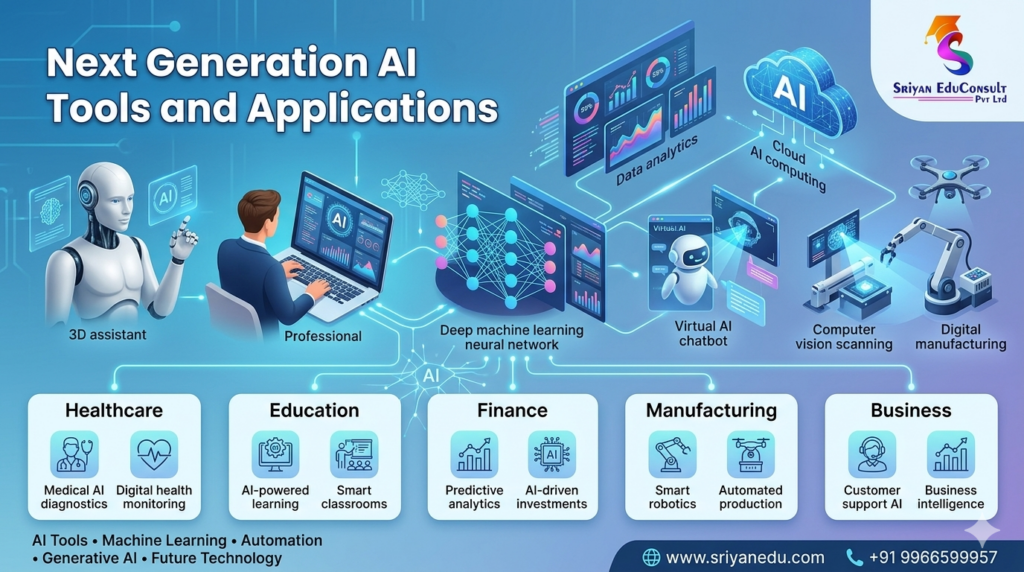
Artificial Intelligence (AI) is evolving at an extraordinary pace, reshaping industries, businesses, and everyday life. The emergence of next generation AI tools and applications has introduced smarter automation, enhanced decision-making, and innovative solutions that were once considered impossible. From healthcare and education to finance and manufacturing, AI is becoming a driving force behind digital transformation.
Organizations worldwide are adopting advanced AI technologies to improve productivity, reduce operational costs, and create better customer experiences. As AI continues to evolve, understanding the latest tools and their applications is essential for students, professionals, and businesses looking to stay ahead in a competitive landscape.
What Are Next Generation AI Tools and Applications?
Next generation AI tools are advanced software solutions powered by machine learning, deep learning, natural language processing (NLP), computer vision, and generative AI technologies. These tools can analyze vast amounts of data, learn from patterns, and make intelligent decisions with minimal human intervention.
Unlike traditional software, modern AI systems continuously improve through learning and adaptation, enabling them to perform increasingly complex tasks efficiently.
Key Characteristics of Next Generation AI Tools
- Self-learning capabilities
- Real-time data processing
- Predictive analytics
- Natural language understanding
- Advanced automation
- Personalized recommendations
- Enhanced decision support
- Multimodal intelligence (text, image, audio, and video)
Top Next Generation AI Tools
1. Generative AI Platforms
Generative AI tools can create text, images, videos, code, and other content based on user inputs. These platforms are transforming content creation, software development, and digital marketing.
Applications:
- Content writing
- Graphic design
- Video generation
- Software coding assistance
- Marketing campaigns
2. AI-Powered Virtual Assistants
Modern virtual assistants have evolved beyond simple voice commands. They can understand context, provide intelligent recommendations, and automate workflows.
Applications:
- Customer support
- Appointment scheduling
- Business process automation
- Personal productivity management
3. Computer Vision Systems
Computer vision enables machines to interpret and analyze visual information from images and videos.
Applications:
- Facial recognition
- Quality inspection in manufacturing
- Medical imaging analysis
- Security surveillance
- Autonomous vehicles
4. Predictive Analytics Tools
These AI solutions analyze historical and real-time data to forecast future outcomes and trends.
Applications:
- Demand forecasting
- Risk assessment
- Financial planning
- Sales prediction
- Supply chain optimization
5. AI Coding Assistants
AI-driven coding tools help developers write, review, and optimize code more efficiently.
Applications:
- Code generation
- Bug detection
- Software testing
- Documentation creation
- Development acceleration
Major Applications of Next Generation AI
AI in Healthcare
Healthcare is one of the biggest beneficiaries of AI innovation. Advanced AI systems assist doctors in diagnosing diseases, predicting patient outcomes, and developing personalized treatment plans.
Benefits:
- Faster diagnosis
- Improved patient care
- Reduced medical errors
- Drug discovery acceleration
- Remote patient monitoring
AI in Education
The education sector is experiencing a significant transformation through AI-powered learning platforms.
Benefits:
- Personalized learning experiences
- Intelligent tutoring systems
- Automated assessments
- Student performance analytics
- Adaptive learning pathways
Students seeking technology-focused programs can gain valuable exposure to AI-related subjects through reputed institutions and educational guidance providers such as Sriyan Educonsultancy.
AI in Business Operations
Businesses leverage AI to automate repetitive tasks, optimize workflows, and improve customer engagement.
Benefits:
- Enhanced productivity
- Cost reduction
- Better customer service
- Data-driven decision making
- Operational efficiency
AI in Finance
Financial institutions use AI to improve security, risk management, and customer experiences.
Benefits:
- Fraud detection
- Credit scoring
- Investment analysis
- Algorithmic trading
- Financial forecasting
AI in Manufacturing
Smart factories are adopting AI technologies to improve production quality and operational efficiency.
Benefits:
- Predictive maintenance
- Quality control
- Inventory optimization
- Process automation
- Reduced downtime
Emerging Trends in Next Generation AI
Multimodal AI
Multimodal AI systems can process and understand multiple forms of data simultaneously, including text, images, audio, and video.
Autonomous AI Agents
AI agents are becoming capable of independently performing complex tasks, making decisions, and interacting with various systems without constant human supervision.
Explainable AI (XAI)
As AI adoption grows, organizations require transparency in decision-making processes. Explainable AI helps users understand how AI systems arrive at conclusions.
Edge AI
Edge AI processes data directly on devices instead of relying entirely on cloud infrastructure, resulting in faster performance and enhanced privacy.
AI-Powered Cybersecurity
Advanced AI systems detect and prevent cyber threats by analyzing patterns and identifying unusual activities in real time.
Benefits of Next Generation AI Tools
Increased Efficiency
AI automates repetitive tasks, allowing employees to focus on strategic and creative activities.
Better Decision Making
Organizations can leverage AI-generated insights to make informed decisions based on data rather than assumptions.
Enhanced Customer Experiences
AI enables personalized interactions, improving customer satisfaction and loyalty.
Scalability
Businesses can expand operations more efficiently using AI-powered automation and analytics.
Innovation Opportunities
AI opens new possibilities for product development, service enhancement, and market expansion.
Challenges of AI Adoption
Despite its benefits, AI implementation comes with several challenges:
- Data privacy concerns
- Ethical considerations
- High implementation costs
- Skill gaps in AI expertise
- Regulatory compliance requirements
- Algorithm bias risks
Organizations must address these challenges through responsible AI governance and continuous monitoring.
Future of AI Tools and Applications
The future of AI promises even more intelligent, adaptive, and collaborative systems. As technology advances, AI will become deeply integrated into everyday activities, workplaces, and industries. Businesses that embrace AI innovation early will gain significant competitive advantages in productivity, customer engagement, and operational excellence.
Emerging technologies such as quantum computing, advanced neural networks, and autonomous systems are expected to further accelerate AI capabilities. The next decade will likely witness unprecedented growth in AI-powered solutions across virtually every sector.
Conclusion
Next generation AI tools and applications are revolutionizing industries by enabling smarter automation, enhanced decision-making, and innovative problem-solving capabilities. From healthcare and education to finance and manufacturing, AI is driving efficiency, productivity, and digital transformation on a global scale.
As AI technology continues to evolve, organizations and individuals who understand and adopt these advancements will be better positioned for future success. Investing in AI knowledge, skills, and implementation strategies is no longer optional—it is becoming essential in today’s rapidly changing digital landscape.
🔗 Visit: https://www.sriyanedu.com/
📞 Contact us today : +91 9966599957
Frequently Asked Questions
1. What are Next Generation AI Tools and Applications?
Next Generation AI Tools and Applications are advanced artificial intelligence solutions that use machine learning, deep learning, natural language processing, and automation to perform complex tasks, improve efficiency, and support decision-making across industries.
2. How are Next Generation AI Tools and Applications transforming businesses?
Next Generation AI Tools and Applications help businesses automate repetitive tasks, analyze large datasets, enhance customer experiences, optimize operations, and improve overall productivity while reducing costs.
3. Which industries benefit the most from Next Generation AI Tools and Applications?
Industries such as healthcare, education, finance, manufacturing, retail, logistics, and information technology benefit significantly from Next Generation AI Tools and Applications through improved efficiency, accuracy, and innovation.
4. What are some common examples of Next Generation AI Tools and Applications?
Popular examples include AI-powered chatbots, virtual assistants, predictive analytics platforms, computer vision systems, generative AI tools, autonomous vehicles, and intelligent recommendation engines.
5. What is the future of Next Generation AI Tools and Applications?
The future of Next Generation AI Tools and Applications includes smarter automation, autonomous AI agents, multimodal AI systems, enhanced cybersecurity solutions, and greater integration of AI into everyday business and personal activities.